
Choosing the Right Timber and Finishes for Custom Joinery
Choosing materials for custom joinery is about much more than finding a colour or timber grain you like. The material beneath the surface, the way cabinetry is constructed and the finish applied to it all influence how your kitchen looks, feels and performs over time.
For a custom kitchen, these choices become particularly important. Cabinetry is used every day, often for decades, so materials need to suit both the design of the home and the realities of a busy household.
From the warmth and character of American Oak to the clean appearance of painted kitchen cabinets, there is no single material that is right for every project. The best result comes from understanding how different custom joinery materials behave and selecting them according to where and how they will be used.
At Steding Interiors & Joinery, material selection forms part of a broader approach to creating cabinetry that is designed for the individual home rather than produced as a standard, off-the-shelf product.
Why Material Selection Matters in Custom Joinery
One of the advantages of custom joinery is choice.
Rather than designing a kitchen around predetermined cabinet sizes and finishes, bespoke cabinetry allows the materials, construction and detailing to work together. This creates opportunities to introduce natural timber, painted cabinetry or a combination of finishes throughout the same room.
The decision should balance four things: appearance, durability, maintenance and suitability for the chosen style.
A highly decorative French Provincial kitchen, for example, may call for a very different finish from a contemporary kitchen with restrained detailing. Similarly, a family kitchen that experiences constant daily use may have different practical requirements from cabinetry in a formal entertaining space.
Understanding those differences early in the design process helps create a kitchen that continues to work well long after the initial renovation is complete.
American Oak: Character Without Excess
American Oak is an enduring choice for custom cabinetry because it brings natural texture into a room without necessarily making the space feel overly rustic.
Its distinctive grain gives cabinetry depth and variation that cannot be completely replicated by an artificial timber pattern. Depending on the way it is cut, detailed and finished, American Oak can work comfortably in traditional and contemporary interiors.
For timber kitchen cabinets, this versatility is valuable.
American Oak can be used across an entire bank of cabinetry, but it can be equally effective as an accent. An island, display cabinet, open shelving, internal cabinetry or another carefully selected feature can introduce the warmth of timber without visually dominating the kitchen.
The final appearance also depends heavily on the finish. Clear or lightly toned coatings allow the grain to remain prominent, while stains can alter the overall tone while retaining the natural character of the timber.
Most importantly, genuine timber is not perfectly uniform. Variations in colour and grain are part of its appeal. Rather than expecting every door or panel to look identical, natural timber should be selected because of those individual characteristics.
The Appeal of Natural Timber
Natural timber has a quality that changes subtly with its surroundings.
Where a painted surface provides consistency, timber provides variation. Grain direction, figuring and natural tonal differences mean every piece contributes something slightly different to the finished joinery.
That makes timber particularly effective in kitchens intended to feel established rather than temporary or trend-driven.
It also works beautifully alongside other traditional materials such as natural stone. In a contemporary setting, timber can soften crisp architectural lines and introduce warmth to an otherwise restrained palette.
Steding has also worked with reclaimed hardwood in bespoke kitchen projects, staining and varnishing timber surfaces to both respect their existing character and provide protection. This demonstrates another advantage of genuinely custom joinery: materials can be selected and treated according to the individual project rather than forcing every kitchen into the same specification.
Natural timber does, however, need an appropriate protective finish. Kitchens are demanding environments where cabinetry is exposed to moisture, grease, heat and frequent handling. The coating system therefore plays an important role in the long-term performance of timber kitchen cabinets.
Painted Kitchen Cabinets: Timeless and Versatile
There is a reason painted cabinetry remains a defining feature of Shaker, Hampton, Country and French Provincial kitchens.
Paint provides enormous design flexibility.
Soft whites and neutral shades can create an understated background, while deeper colours can turn an island or bank of cabinetry into a strong architectural feature. Different colours can also be combined within one kitchen to distinguish individual elements without changing the overall cabinetry style.
The material beneath the paint is just as important as the colour.
For painted Shaker kitchens, Steding recommends machine-grade MDF as a stable and cost-effective material capable of producing a durable, seamless painted finish. Its consistency makes it particularly well suited to cabinetry where the intention is to create a smooth painted surface rather than display natural grain.
Construction details matter too. Steding’s frame-constructed Shaker doors are made in house, and rounded edges are incorporated at joins to help create a strong sealed finish and reduce the risk of cracking.
It is a useful reminder that good painted kitchen cabinets are not simply timber-look doors covered with paint. Substrate, door construction, preparation and finishing all contribute to the result.
Understanding Painted Finishes
Not every painted finish produces the same appearance.
A quality sprayed finish can create a smooth and consistent surface particularly suited to kitchens where clean detailing is important. Steding has used durable 2-pac spray-painted finishes on its custom cabinetry, including traditional Shaker and Country-style kitchens.
A hand-painted or aged finish creates a different effect.
In a French Provincial kitchen, for example, subtle ageing or a scumble treatment can emphasise mouldings, profiles and decorative cabinetry. Instead of trying to make every surface appear completely uniform, the finish contributes to the character of the kitchen.
This is why choosing a finish should happen alongside choosing the kitchen style. The finish is not simply the final coat applied after the cabinetry has been built; it is part of the overall design.
Combining Painted Cabinetry and Natural Timber
You do not necessarily need to choose between painted cabinetry and timber.
Some of the most balanced kitchens use both.
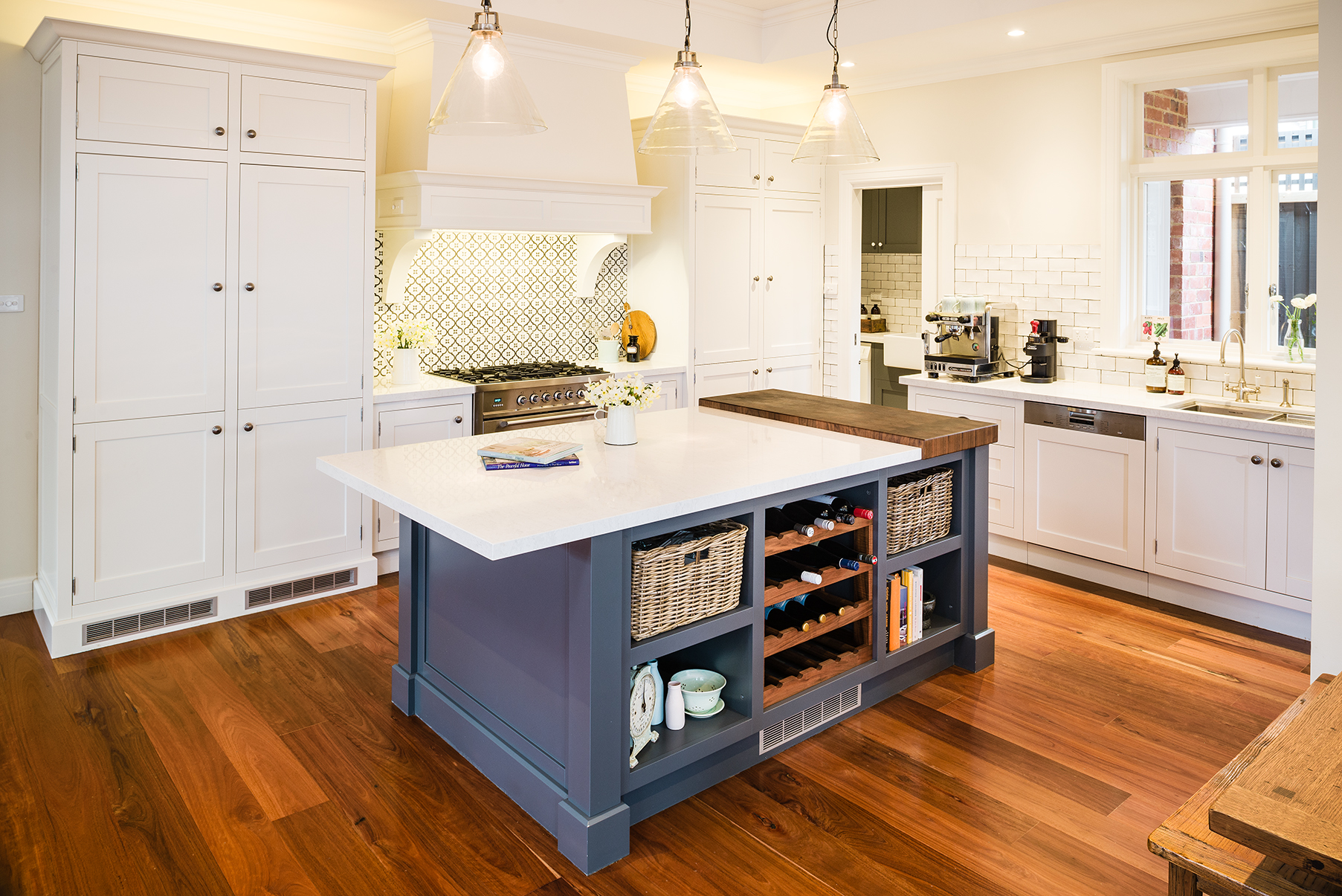
A predominantly painted kitchen might incorporate a natural timber island, shelving or cabinetry interiors. Alternatively, timber cabinetry can be paired with painted sections to prevent a large kitchen from becoming visually heavy.
Combining materials can also help define different functions within an open-plan room. An island may be treated more like an individual piece of furniture, while perimeter cabinetry adopts a quieter painted finish.
The key is restraint.
Too many unrelated finishes can make custom joinery feel fragmented. Repeating timber tones or paint colours elsewhere in the room — through flooring, furniture, architectural details or other joinery — can help the overall interior feel considered.
Durability Starts Below the Surface
When comparing custom joinery materials, it is easy to concentrate on visible surfaces. Yet durability is also determined by construction.
Door construction, cabinet construction, drawer boxes, hinges, runners and joints all influence how cabinetry performs.
Steding’s approach includes traditional methods such as frame-constructed Shaker doors, face-frame cabinetry and solid timber dovetailed drawer boxes. Face frames add strength to the front of the cabinet while also forming an important visual feature in traditional joinery.
These details matter because kitchens are highly active spaces.
Doors may be opened thousands of times. Drawers carry significant weight. Areas around sinks are exposed to moisture, while cabinetry near ovens and cooktops experiences regular temperature changes.
A beautiful finish cannot compensate indefinitely for poorly constructed cabinetry. Conversely, carefully manufactured joinery combined with an appropriate finish provides a much stronger foundation for long-term performance.
Maintaining Timber Kitchen Cabinets
Natural timber does not need to be difficult to maintain, but it should be treated with appropriate care.
For routine cleaning, remove dust and marks with a soft cloth and follow the care requirements for the particular coating used on the cabinetry. Spills should be dealt with promptly, especially around sinks and preparation areas, rather than allowing moisture to sit on the surface.
Avoid harsh abrasive cleaners unless they are specifically approved for the finish. They can dull or damage protective coatings over time.
It is also worth remembering that timber is a natural material. Some variation and gradual change in appearance can occur as the kitchen ages and is exposed to light. For many homeowners, this developing character is part of the attraction of choosing genuine timber.
Caring for Painted Kitchen Cabinets
Painted cabinetry is similarly straightforward to care for when treated sensibly.
Regular light cleaning is preferable to allowing grease and grime to build up and then relying on aggressive cleaning products. A soft cloth and a cleaning method appropriate for the specified paint system will generally help preserve the surface.
Particular attention should be paid to frequently touched areas around handles, drawer fronts and cooking zones.
Good ventilation also matters in any kitchen. Managing steam and cooking residue helps protect cabinetry and other finishes throughout the room.
With painted cabinetry, minor marks may naturally become more noticeable on certain colours and sheen levels than others. This is worth discussing during material selection, particularly for busy family kitchens.
Which Finish Is Right for Your Kitchen?
The answer depends on the home and the way you want the kitchen to feel.
Choose natural timber when genuine grain, warmth and material variation are central to the design. American Oak is particularly useful when you want natural character that can adapt to either traditional or more contemporary cabinetry.
Choose painted cabinetry when colour flexibility and a consistent surface are priorities. Painted Shaker cabinetry is especially suited to Hampton, Country, Traditional English and French Provincial interiors, although painted finishes can work equally well in contemporary designs.
Or combine the two.
Custom joinery provides the freedom to use each material where it works best rather than making one finish do everything.
Quality Materials Deserve Quality Craftsmanship
Selecting the right timber and finish is only part of creating cabinetry that will stand the test of time. The quality of the design, construction, finishing and installation is equally important.
Steding Interiors & Joinery designs and manufactures its custom kitchens in Melbourne, with manufacturing processes including machining, assembly, surface treatment and finishing undertaken in house. This allows the details of the cabinetry to be considered as part of one complete process.
Whether your preference is the warmth of timber kitchen cabinets, the refined appearance of painted kitchen cabinets, or a carefully considered combination of both, the best result begins with materials selected for the specific project.
When those materials are combined with thoughtful design and traditional craftsmanship, custom joinery becomes more than kitchen storage. It becomes a lasting part of the home.